
Introduction
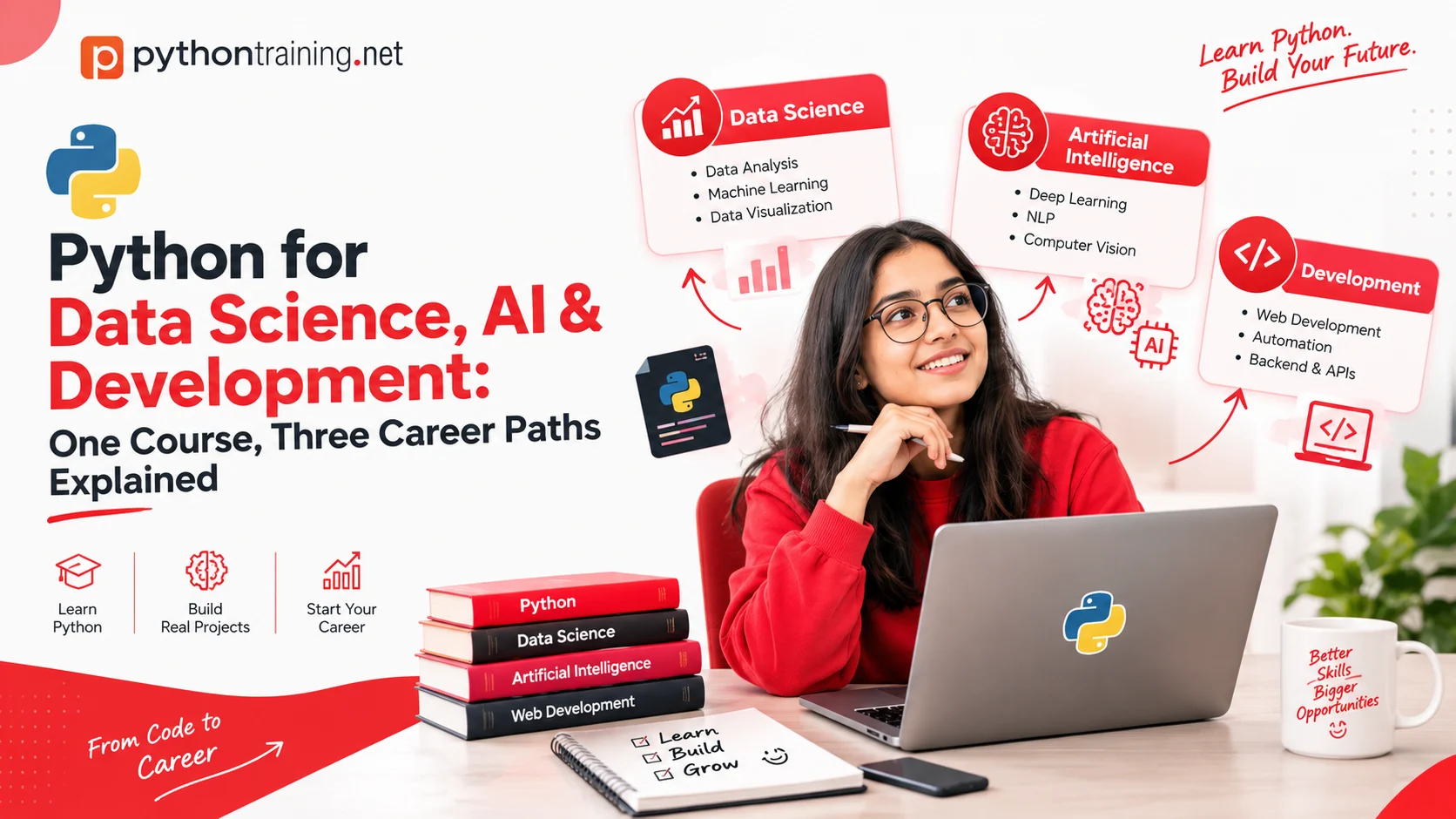
Ask ten people why they want to learn Python and you’ll hear ten different answers. One wants to analyze data. Another wants to build AI models. A third wants to create apps and automate work. All of them are right, because Python is one of the few languages that sits at the center of all three fields.
That’s exactly why a combined Python for Data Science, AI & Development course makes sense. You build one strong foundation, then choose, or even combine, the direction that fits you best. This guide explains the three career paths, how they differ, what they share, and how to decide which one to pursue.
Why One Python Course Can Lead to Three Careers
The three paths look different on the surface but rest on the same ground:
- Data science uses Python to clean, analyze, and model data
- AI and machine learning use Python to train systems that learn from data
- Software development uses Python to build applications, automate tasks, and power back ends
The libraries differ, but the core skills of writing clean code, handling data, structuring logic, and debugging are identical. Learn them once, and you can move between paths far more easily than if you started in three separate technologies.
The Three Paths at a Glance
| Data Science | AI & Machine Learning | Python Development | |
|---|---|---|---|
| Core question | What does the data tell us? | Can a system learn to predict or decide? | How do we build and automate this? |
| Typical output | Insights, reports, dashboards, predictive models | Trained models, intelligent features, AI applications | Apps, APIs, scripts, automation tools |
| Key Python tools | Pandas, NumPy, Matplotlib, Seaborn | Scikit-learn, TensorFlow, PyTorch | Flask or Django, APIs, databases |
| Math intensity | Moderate to high (statistics) | High (statistics, linear algebra) | Low to moderate |
| Best for | Analytical, curious, story-driven thinkers | Research-minded, math-comfortable builders | Practical builders who like seeing things work |
The Shared Foundation: What Every Path Needs
Before the paths split, everyone needs the same base. A solid Python program starts with:
| Foundation Topic | Why It Matters |
|---|---|
| Variables, data types, and operators | The building blocks of every program |
| Conditional statements and loops | Controlling logic and automating repetition |
| Functions and modular coding | Writing reusable, organized code |
| Lists, tuples, sets, and dictionaries | Handling collections of data, central to all three paths |
| String operations | Cleaning and processing text data |
| File handling | Reading and writing real-world data |
| Error handling and debugging | Making programs reliable and fixing problems quickly |
Skipping this stage is the most common reason learners struggle later. Data science, AI, and development all assume you can write and read Python comfortably.
Path 1: Python for Data Science
What it is: Turning raw data into decisions. Data scientists collect, clean, explore, and model data to answer business questions and predict outcomes.
What you learn on this path:
- Data handling with NumPy and Pandas
- Data cleaning, missing values, and feature preparation
- Exploratory analysis and visualization with Matplotlib and Seaborn
- Statistics and probability fundamentals
- Introductory predictive modeling
What you can build: A sales analysis dashboard, a customer churn predictor, a report that explains why numbers moved.
Career roles: Data Analyst, Business Analyst, Junior Data Scientist, Reporting and BI Analyst.
Who it suits: People who enjoy finding patterns, explaining findings clearly, and working closely with business teams.
Path 2: Python for AI and Machine Learning
What it is: Building systems that learn from data. Instead of writing every rule by hand, you train models that improve with examples.
What you learn on this path:
- Supervised and unsupervised machine learning
- Model training, evaluation, and tuning
- Neural networks and deep learning basics
- Working with text and images (NLP and computer vision introductions)
- Using and deploying AI models in applications
What you can build: A spam classifier, an image recognition tool, a recommendation engine, a simple chatbot.
Career roles: Machine Learning Engineer, AI Engineer, Junior AI Developer, Generative AI Developer.
Who it suits: People comfortable with math and experimentation, and curious about how intelligent systems actually work.
Path 3: Python for Development and Automation
What it is: Using Python to build working software: web back ends, APIs, scripts, and automation that saves hours of manual work.
What you learn on this path:
- Object-oriented programming
- Web frameworks such as Flask or Django
- Working with APIs and databases
- Automation scripts for files, reports, and repetitive tasks
- Testing, version control, and deploying applications
What you can build: A web app with user logins, an automated reporting script, an API that serves data to a front end.
Career roles: Python Developer, Back-End Developer, Automation Engineer, Full-Stack Developer (when paired with front-end skills).
Who it suits: Hands-on builders who like turning ideas into working products.
Where the Paths Overlap
The real advantage of learning all three together is how often they meet in real jobs:
| Real-World Scenario | Paths Involved |
|---|---|
| A model predicts customer churn, then an app shows the results to the sales team | Data science + AI + development |
| An automated script cleans daily data and updates a dashboard | Development + data science |
| A web app calls a trained model to recommend products | Development + AI |
| A chatbot built on a language model, wrapped in an API | AI + development |
Professionals who can cross these lines are especially valuable, because they can take an idea from raw data all the way to a deployed product.
How to Choose Your Path
You don’t need to decide on day one, but these questions help:
| If you… | Lean toward |
|---|---|
| Enjoy spreadsheets, charts, and explaining “why” | Data science |
| Are fascinated by how machines learn and are comfortable with math | AI and machine learning |
| Like building tools, apps, and automating boring tasks | Development |
| Want the widest range of options early on | Start with the shared foundation and decide midway |
| Come from a non-technical background | Begin with data analysis or automation, then grow into AI |
A practical rule: finish the Python fundamentals first, then try a small project in each direction. Which one you lose track of time on usually tells you where to specialize.
What a Combined Course Should Deliver
When comparing programs, look for a curriculum that covers:
- Python fundamentals taught properly, not rushed
- Data handling and analysis with real datasets
- Machine learning and AI model building
- Building and deploying small applications
- Projects at every stage, not only at the end
- Portfolio and interview support, since projects and explanation skills decide job offers
The pythontraining.net program, Python for Data Science, AI & Development, is described as combining Python fundamentals, data handling, machine learning, AI models, and building and deploying smart applications in one program.
How Long Does It Take?
Timelines vary with your starting point and weekly hours. Python Training Institute’s own courses typically run about 2 to 6 months depending on depth and specialization. A realistic way to read that:
| Goal | Typical Effort |
|---|---|
| Comfortable with Python fundamentals | 6 to 8 weeks of steady practice |
| Entry-level data analysis or automation skills | About 3 months |
| Data science and machine learning at working level | 4 to 6 months with projects |
| Deeper AI specialization | Longer, and ongoing learning after the course |
A 3-month Python course can cover the essentials for entry-level roles, while extended programs suit those aiming for mastery in data science, machine learning, or AI.
Common Mistakes to Avoid
- Jumping to machine learning too early. Weak Python basics make every later topic harder
- Picking a path from hype alone. Choose based on the work you’d actually enjoy
- Learning libraries without understanding the logic. Copy-pasting code won’t survive an interview
- Skipping projects. Employers hire on evidence, not module lists
- Ignoring communication. Data scientists, AI engineers, and developers all need to explain their work to non-technical teammates
- Learning alone without feedback. Code reviews and doubt sessions save weeks of confusion
Why Classroom Training Helps
Self-study works for some, but Python learners often stall in the same places: the jump from basics to real projects, debugging unfamiliar errors, and choosing what to learn next. A structured classroom environment helps through small batches, live doubt sessions, regular assessments, and mentors who’ve worked in the field. Python Training Institute in Delhi runs offline classroom training with options for online learning, along with placement assistance, resume support, and interview preparation.
Where to Learn in Delhi
Python Training Institute in South Extension, New Delhi offers classroom-based, project-driven Python training with free demo classes, so you can meet the trainers and see the teaching style before enrolling. Once your Python foundation is in place, you can go deeper into each path with dedicated programs: the Data Science Course in Delhi, the Machine Learning Course in Delhi, the AI Course in Delhi, and the Generative AI Course in Delhi. For the development side, there are also the Full Stack Development Course and the Front-End Development Course.
Fees depend on the course length and modules you choose, and installment options are available, so the best step is to ask the admissions team for current pricing and a demo class date.
Frequently Asked Questions
Can one Python course really prepare me for data science, AI, and development? It can give you the shared foundation and an introduction to each area. Most learners then specialize in one direction through projects and further study.
Which path is easiest for a beginner? Python development and data analysis are usually the gentlest starting points. AI and machine learning demand more math and are easier once Python and data handling feel natural.
Do I need a computer science degree? No. Many successful learners come from commerce, arts, design, or other fields. Skills and projects matter more than your degree.
Is Python enough to get a job? Python can qualify you for entry-level roles when combined with practical experience. Adding data science, machine learning, or AI skills improves your options.
How long should I study each week? Around 10 to 15 focused hours a week is realistic for steady progress. More hours shorten the timeline.
Can I change paths later? Yes. Because the foundation is shared, moving from analysis to machine learning, or from development to AI, is much easier than starting over.
Is there a demo class? Yes. Python Training Institute offers free demo classes at its Delhi center.
Final Thoughts
Data science, AI, and development aren’t three separate worlds. They’re three doors off the same hallway, and Python is the hallway. A combined course lets you build the foundation once, explore each direction with real projects, and choose with confidence instead of guessing.
Start with the fundamentals, build something small in each direction, and notice what pulls you in. That’s the path to specialize in, and with Python under your belt, the others stay open.
Ready to start your Python journey? Visit Python Training Institute to book a free demo class and talk to a counselor about the right path for your goals.